MSEdgeExplainers
Writingsuggestions attribute to control UA-provided writing assistance
Consider all sections required unless otherwise noted.
Authors: Sanket Joshi Previous authors: Ben Mathwig
Status of this Document
This document is a starting point for engaging the community and standards bodies in developing collaborative solutions fit for standardization. As the solutions to problems described in this document progress along the standards-track, we will retain this document as an archive and use this section to keep the community up-to-date with the most current standards venue and content location of future work and discussions.
- This document status: ARCHIVED
- Current venue: WHATWG | whatwg/html
- Current version: writingsuggestions attribute
Introduction
UAs are starting to provide writing suggestions to users as they type on various editable fields across the web (see the use case section below). While this is generally useful for users, there are cases when developers may want to turn off UA-provided writing assistance, such as extensions or sites that wish to provide similar functionality on their own. To that end, this explainer proposes a solution that would allow developers to turn on/off UA-provided writing assistance.
Use Case
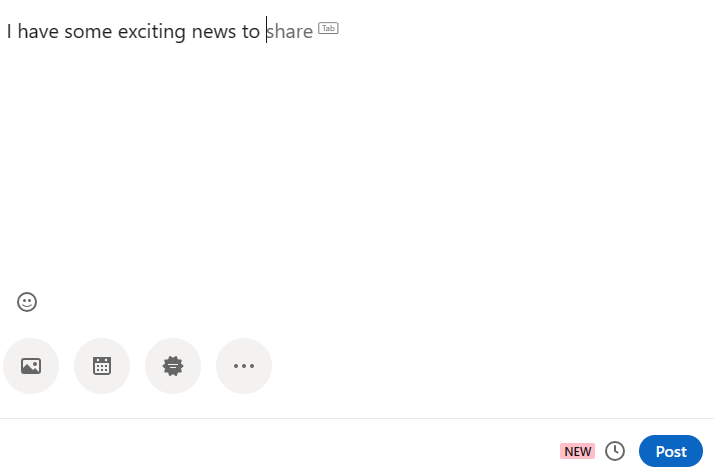
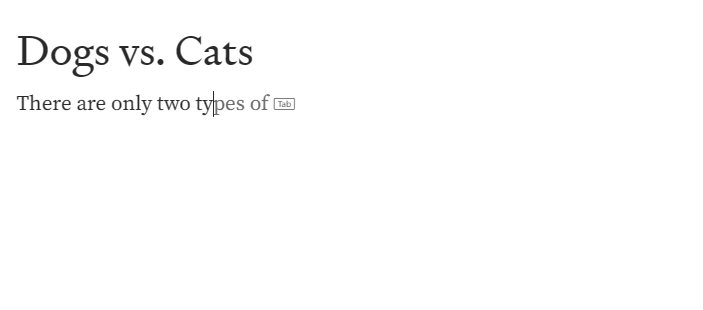
A developer may use this control to take advantage of browser-provided writing assistance features like text prediction on contenteditable elements.
Facebook.com: Writing a post
Medium.com: Drafting an article
Youtube.com: Commenting on a video

This control could also be used to enable additional browser-provided writing suggestions in the future. See a hypothetical example below.
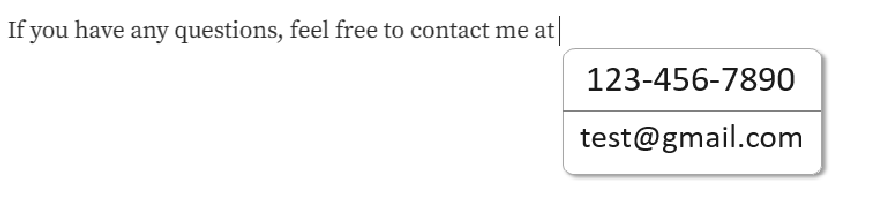
A developer may also use this control to turn off browser-provided writing suggestions if they want to provide their own writing assistance tools.
Out of Scope
- Defining expected user agent behavior or user interface design.
- Styling of UA-provided writing suggestions.
Proposed Solution
We propose the addition of a new attribute called writingsuggestions with values on/off that would allow developers to turn on/off browser-provided writing suggestions. This attribute will have a default state per element, as established by the UA. The attribute's state for an element can also be inherited from ancestor elements, thereby allowing developers to control this functionality at a per-element or per-document/sub-document scale.
Privacy and Security Considerations
UAs may choose to provide users with personal settings to turn on/off writing assitance, similar to settings that are available for spellchecking. Similar to the spellcheck attribute, UAs must keep the values of the writingsuggestions attribute independent of the user's settings. Letting the user's setting influence the value of the attribute may introduce a new fingerprinting surface.
Alternative Solutions
Extending the autocomplete attribute to editing hosts
The autocomplete attribute is primarily designed for form fill scenarios and supports a large number of values, many of which are not applicable to writing scenarios. Reasoning about how each of these values should behave on editing hosts would be complex for browser and web developers alike.
Spellcheck Attribute
The spellcheck attribute is specifically designed to control the browser's spellcheck and grammar check capabilities, therefore it is not semantically appropriate for controling writing suggestions.
Text Prediction Attribute
A textprediction attribute could be introduced that takes on/off values, allowing developers to control whether the browser's text prediction is available on a text control. Such an attribute would be specific to text prediction and would not be future proof against additional types of writing suggestions that browsers may introduce in the future.